The Australian building sector is undergoing a quiet but severe regulatory recalibration. Between the incoming National Construction Code (NCC) 2025 and the tightening grip of the NSW Design and Building Practitioners (DBP) Act, the definition of professional liability has fundamentally expanded.
Yesterday's professional indemnity coverage will leave many mid-market building professionals completely exposed tomorrow. Insurance brokers are standing between complex new statutory duties and a client who likely just wants to renew their policy at last year's premium.
The tension is palpable. Clients are focused on keeping projects moving, while the courts and regulators are quietly rewriting the rules of accountability behind the scenes.
A clear framework is needed to explain why standard limits and legacy policy wordings are no longer fit for purpose. This requires translating dense legalese into actionable risk management, without relying on fear tactics to make the point.
The Legislative Reality: What's Actually Changed?
The regulatory landscape is shifting from a patchwork of state guidelines to strict, mandatory compliance. In New South Wales, the current exemption from holding mandatory PI insurance for building practitioners under the DBP Act is proposed to end on 30 June 2027.
Once that transition period concludes, mandatory PI becomes the absolute barrier to entry for all registered practitioners. This is not a distant problem; the underwriting assessments for those 2027 policies will be based on the risk management frameworks your clients are implementingright now.
Simultaneously, NSW has confirmed the adoption of NCC 2025 for May 2027. This update increases design and compliance exposures across the board, forcing insurers to scrutinise scopes of work far more closely.
But this is not just a New South Wales issue. The regulatory tightening is a national trend that impacts every mid-market firm.
- Queensland: minimum PI limits for specific registered engineers will increase to $2 million per claim by July 2026.
- Victoria: the Architects Registration Board now demands continuous 12-month cover with strict alignment declarations, penalising any gaps in coverage periods.
- South Australia: recently increased its statutory contract threshold for domestic building work to $20,000, pulling smaller projects into the regulatory net.
For your clients, this means the compliance net is catching a much wider array of daily operations.
The focus has moved from simple negligence to strict statutory compliance. A mid-market design firm or builder can now trigger a liability event simply by failing to meet a newly minted code requirement, even if their actual workmanship was sound.
Translating the Mandates: Calculating Adequate Limits
Determining an adequate limit of indemnity is no longer about picking a comfortable baseline figure or rolling over last year's number. Adequacy is now a risk-based standard driven entirely by recent court decisions.
The High Court ruling in Pafburn v The Owners – Strata Plan No 8467 fundamentally reshaped how liability is apportioned in the building sector. The statutory duty of care under the NSW DBP Act is now considered non-delegable.
Developers and head contractors can no longer easily rely on "proportionate liability" to limit their exposure by pointing the finger at subcontractors. The courts expect the primary entity to bear the weight of the failure.
"Your client's PI policy may now need to respond to the full value of a defect claim, rather than just their proportionate share of the blame."
This joint and several liability exposure means standard limits are often drastically undercooked. Consider a scenario where a mid-market builder faces an $8 million rectification claim.
If they assumed they would only be liable for 20% of the damages, a $2 million PI limit seemed perfectly adequate. Under the new precedent, they could be held liable for the entire $8 million, leaving them severely underinsured.
While $1 million to $2 million might suffice for lower-risk engineering classes, $5 million is rapidly becoming the absolute floor for mainstream building and design consultancies. For major commercial projects, high-rise residential, or Design & Construct (D&C) exposures, $10 million or more is the new benchmark.
When a client asks why they need to increase their limit this year, the answer is straightforward. You tell them that the courts now expect the last firm standing to foot the entire bill for a structural defect, and their insurance limit must reflect that harsh reality.
The Hidden Exposure: Why Insurer Quality Ratings Matter
In a volatile regulatory environment, the financial security of the carrier holding the risk is just as important as the policy wording itself. Long-tail building defects require capital depth that can survive years of complex, drawn-out litigation.
The Australian Prudential Regulation Authority (APRA) has recently intensified its oversight of the insurance sector. They are specifically monitoring how global market complexity, and geopolitical tensions affect Australian institutions' exposure to offshore developments.
While APRA has not issued a blanket warning against unrated offshore construction PI insurers, their regulatory direction is clear. They are consulting on updates to the National Claims and Policies Database to better monitor trends in PI and public liability insurance, signalling a lower tolerance for weak risk management.
Placing a complex building risk with an unrated or poorly rated insurer introduces a severe secondary risk for your client. These carriers often lack the balance sheet to pay complex claims that emerge five or ten years after a project's completion.
When the market hardens, legacy bureaucracy often slows down claims payments or tightens underwriting appetites. This leaves brokers in the unenviable position of delivering bad news to clients who thought they were protected.
At Subscribe, we believe that underwriting integrity means holding the pen with secure, highly rated capital. You need an agile underwriting partner who understands the granular realities of the Australian building sector and has the financial strength to stand by the policy when a long-tail claim finally matures.
Framing the Conversation with Clients
Transitioning a renewal meeting from a price negotiation to a strategic risk discussion requires a clear, step-by-step approach. Your goal is to make the client realise that their operational reality has changed, even if their day-to-day work looks exactly the same.
- Identify the specific legislative shift impacting their state or licence class. Use the end of the DBP Act exemption or the incoming NCC 2025 as the anchor point for the conversation. Ground the discussion in their specific jurisdiction to make it immediately relevant.
- Explain the Pafburn precedent in plain English. Use the analogy of a restaurant bill: the courts are no longer splitting the bill evenly among everyone at the table. They are handing the entire cheque to whoever has the deepest pockets or the most accessible insurance policy.
- Audit their retroactive dates together. Show them a timeline of their major completed projects and map it against their current policy's retroactive date. Visualising this exposure is highly effective at demonstrating the need for comprehensive run-off cover.
- Present the solution. Show them how an updated policy with a higher limit and a refined civil liability wording acts as a firewall against these new statutory exposures. By translating these complex mandates into practical protection, you stop being a vendor and become an indispensable advisor.
The Australian building industry is facing a period of intense regulatory scrutiny, and standard insurance responses will no longer suffice. Yesterday's compliance is today's exposure.
We are here to help you translate these complex risks into precise, tailored protection for your mid-market clients. Our independent decision-making allows us to adapt to these legislative shifts without the friction of legacy systems.
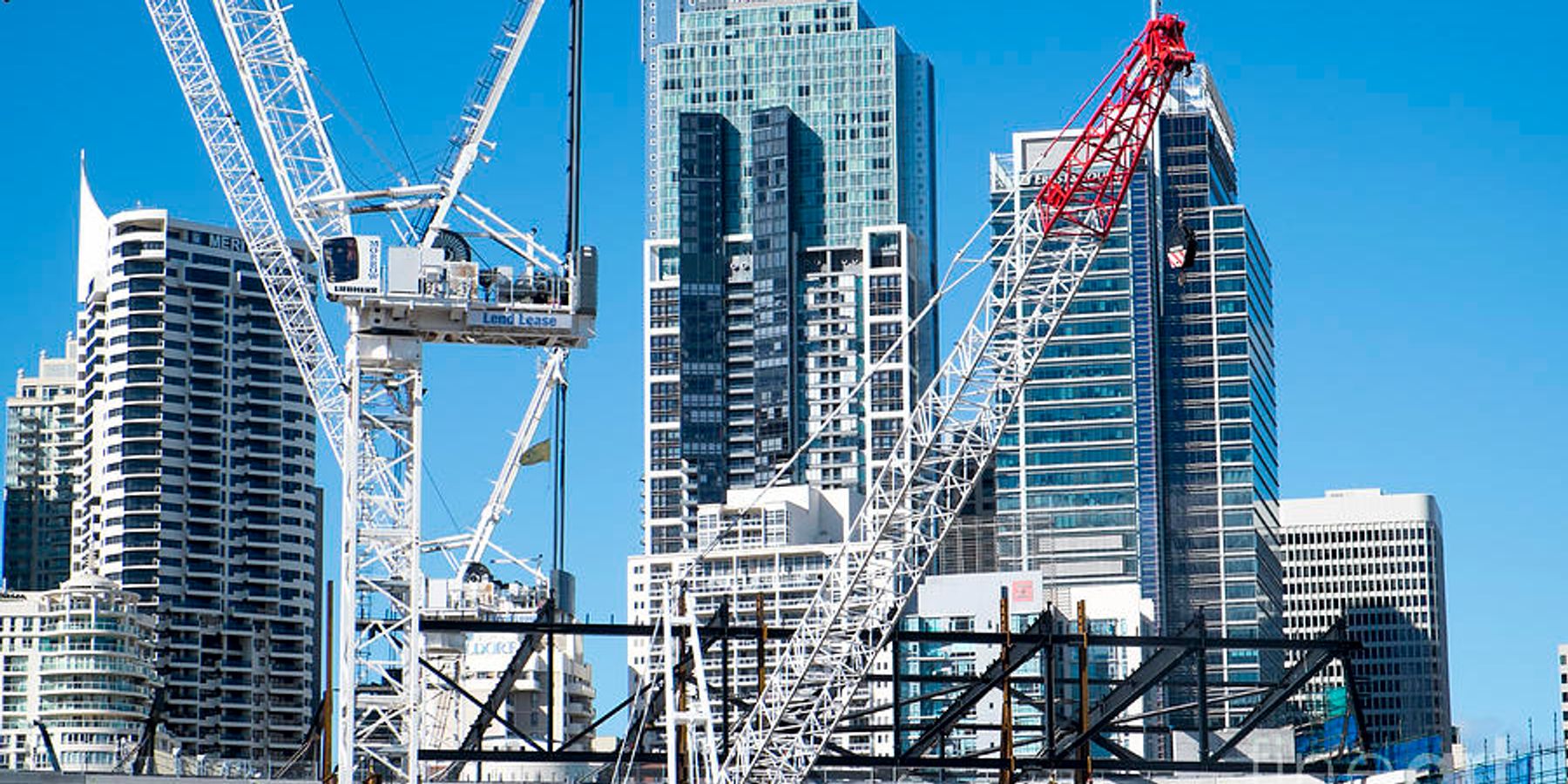
Image: "Sydney City Centre Construction" by Martin Berry, via Fine Art America.